
Dwarves and Gnomes
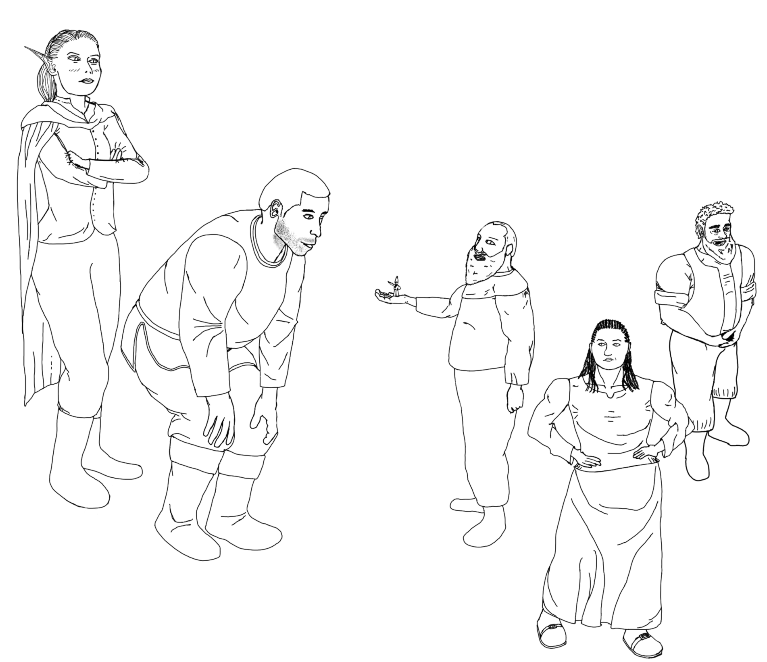
Dwarves (right) showing a gnome (center) to a human and an elf (left)
Overview
Dwarves are a long-lived, reclusive people that largely live beneath the surface in vast underground cities. Their distinctive appearance of approximately one and a half paces in height, but stocky and muscular and, especially, the long beards worn by the males mark them among other humanoids. They are known for efficiency, industry, and exquisite craftsmanship. There are four powerful Dwarven monarchies: Aedon, Dranomar, Medria, and Drenia. While there are other Dwarven political powers, they are small clusters of settlements or isolated city-states.
There is a small diaspora of dwarves that become separated from their home and their people for various reasons. Knowing they will not be accepted by other dwarves, even their own countrymen, they choose to forge a new existence among other civilizations.
Physiology, appearance, and ethnicity
Dwarves generally stand to four feet tall; taller than goblins, but squatter than short humans. They have broad bone frames and tend to be muscular and stocky. This race generally have ruddy skin, especially those who live closer to the surface, though some communities deep underground tend towards paler complexions.
Most have brown eyes, with hair color ranging from blond through red to brown, black, or grey. The male dwarves grow long beards, often reaching down to their bellies or long enough to braid, which some do. Men and women both style their hair as they prefer, long or short, shaved or braided.
Dwarves show signs of their aging in manners similar to humans, but on scales longer by decades. While they reach cultural adulthood at twenty years, aging slows significantly thereafter. A fifty-year-old dwarf will appear to still be in their twenties by human standards. Roughly, ten years of aging for a human appears as one year for a dwarf.
Dwarves seem to be roughly of the same ethnicity across Paeta, separated more by language and geographic barriers rather than any notable physical features.
Culture
Dwarves are an industrious, materialistic, and clannish society. They tend towards xenophobic views, allowing few or no non-dwarves into their cities and settlements. The ownership and production of fine goods is a considerable driver of culture and trade. Most dwarves hold the secrets of their trade very closely–even more so, when non-dwarves are concerned.
The ownership and production, and the ability to produce fine goods is a major driver of culture and trade for hard and soft power. Among their trade secrets are two definitive factors. Firstly, is their alliance with gnomes. Gnomes are humanoids wearing conical hats, small enough to fit several on the palm of a human or Dwarven hand. Gnomes, every bit as sentient as dwarves, are able to help with very precise measurements to aid Dwarven craftsmanship and finishing.
The secondary asset available to craftspeople is Dwarven magic, which largely focuses on a deeper, more agile interaction with crafted materials. Dwarves can achieve higher levels of precision and ask more of the materials they use than most craftspeople of other peoples. Note that though most Dwarven magic is oriented around industry and craft, they also study and practice magic for other purposes, including militaristic.
Society is focused around families and clans (as described in the following section), and align their interests around the clan, sometimes even before immediate family, then to their own governing bodies, then to Dwarvenkind at large. Clans tend to focus on a specific set of crafts and trades, master them, and dominate the local market.
Each city is ruled by a lord or lady, though some realms, such as Drenia, restrict the political power of their women. The more powerful clans represent their interests (such as rights for business ventures, defense, official positions and titles, contract arbitration, etc.) to their lord and fill the role of oligarchs. Smaller settlements are usually governed by a single clan and/or minor lord, but generally jurisdiction falls under the scope of power of a nearby city. Realms are ruled by a king or queen, but have to balance the interests of the influential clans, lords and ladies, and must frequently forge a consensus for successful rule.
Some dwarves leave their communities, whether exiled for crimes, war, or other problems; these dwarves sometimes form their own enclaves, typically underground but occasionally on the surface. Such dwarves are viewed as ‘broken dwarves’ by their fellow dwarves, to which a negative stigma is attached.
Governing Bodies and Societal Organization
Like humans, dwarves are born into highborn and lowborn families. Families that share multiple relations frequently form clans. Clans generally specialize in a particular vocation or several related crafts. Generally, the most powerful highborn clan will hold the title for the city or settlement, but the other powerful clans are represented with seats on a council to which the lord must pay respect. Though there is no official leverage that the other clans have over the lord, each clan has a business and all of the businesses are interrelated.
The ruling clan of each city typically possesses a seat on their monarch’s council. The sovereign of each realm tends to be from the wealthiest, most powerful clan of the realm, and has the power to pass laws and decrees, declare war, make peace, establish and break diplomatic relations, set state policy, and so forth.
Titles tend to be hereditary within clans. Lowborn clans are limited from offices that they may hold. While guildmasters, and even in rare cases generals, may be lowborn, lords and ladies of Dwarven cities and realms must be highborn. However, there is historical precedent for lowborn clans being raised to highborn status, thus providing a not impossible path to higher rankings.
Aedon, Medria, and many of the separate Dwarven city-states hold the rights of men and women to be equal. However, Drenia and Dranomar both limit the power of women in their societies.
Language
Dwarves speak separate languages by realm. The different dialects arose from geographic separation and other influences, but as the realms formed and controlled territory, each chose their mother dialect as an official state language.
Cities and Architecture
Most Dwarven cities are subterranean, built into the walls of both natural and created caverns. They favor larger caverns, for the benefits of air circulation, near underground sources of water, though it is also common for cities and settlements to be located near mineral veins, as the mining trade supplies key industries and exports. Extensive bridging is erected to ease transportation about the cavern, and aqueducts are positioned to supply water throughout. Cities are predominantly made of stone, though some structures are formed of metal; steel, for example, in cases where the structural integrity of stone is unsuitable. These settlements are feats of design and engineering, as well as showcasing the dwarves’ remarkable ability to impose their will on the rock, clay, metals, and soil.
Cities are predominantly composed of residences, most of which are clan halls in which related families dwell, with craft industries and workshops built directly into them. Most cities have several markets. Walkways, bridges, and stairs connect the city’s various zones. The cavern of the city will usually have hand-cranked pulleys attached to cargo elevators to more efficiently transport large amounts of goods and materials over vertical distances.
Most underground roads are cut and maintained by Dwarven settlements, though they have also served as a boon to civilizations that are hostile to dwarves, such as the orcs that conquered and occupied the Drenian city of Ikria. Dwarven roads are generally wide and tall enough for at least two wagons to travel side by side so as to accommodate travelers and caravans to safely pass each other from opposite directions.
Arms and Armor
Dwarven goods are of exquisite quality, surpassing most human-made goods. Even day-to-day wares are crafted, with the assistance of gnomes, Dwarven magic, or simply the Dwarven pride and obsession with quality, to exacting precision. Additionally, the most common application of Dwarven magic focuses on their crafts with the focus of more intimately interacting with the materials, such as altering material strength, heat dispersion, etc.
As it applies to the production of arms and armor, dwarves produce fine mail and resilient plate armor. Most of their warriors wear a combination of mail and plate. Their plate is harder and more durable than even Daearan water steel, yet lighter at the same time, even when crafted by only mundane methods.
Dwarves favor one- and two-handed axes, hammers, and all-steel crossbows. They sometimes carry spears and other polearms and, less commonly, swords. Wood being scarce in the underground realms, most items made from this material are polished wooden sculptures possessed by wealthy clans. Therefore, axe and hammer hafts, spear shafts, and so forth, are frequently manufactured of iron, steel, or other tough metals. They often carry medium-sized steel shields, though larger ones are sometimes carried as part of sieges.
Crossbows are entirely made of steel, as well as the bolts. The limbs generally require magical crafting techniques in order to allow the steel to bend in ways not natural to mined ores. The bowstring and crank cables in the crossbow are steel wire or cable.
Siege weapons for dwarves are primarily great siege crossbows: a large, crew-served crossbow with all steel construction and all steel bolts the size of spears, and battering rams with protective enclosures. These items, too, are generally constructed entirely of steel. The siege crossbows are highly accurate with fine sights and the ability to adjust them precisely with the aid of gnomish crew members.
Organization for war
Dwarven fighting forces across most of the realms organize into legions, though the size and composition of most legions varies by realm and the city in which they are garrisoned. Nearly uniformly, they are well-equipped with heavy armor and melee weapons. Many legions have specialized siege troops and crossbow units. In rare instances, dwarves employ wizards or sorcerers for military purposes. Sorcerers are exceptionally rare and, often, their gifts do not coincide with a military purpose or the craft which their clan holds dear. For more information about sorcery, see The Witches of Serna, Appendix IX: Blood Magic.
Soldier is the lowest rank amongst the Dwarven troops. Sergeants are the most common leader, and the scope of their responsibilities can differ significantly. Some sergeants are in charge of only a few soldiers or occupy some form of staff position, while others have great influence or direct supervision over dozens of soldiers and other junior sergeants. The officer ranks begin with minor captain, major captain, high captain, and general. In most cases, officers in legions are highborn, though there is fairly common precedent for lowborn sergeants that excel and show great valor or cunning to be raised to low captain and progress their career from that point.