
Elves
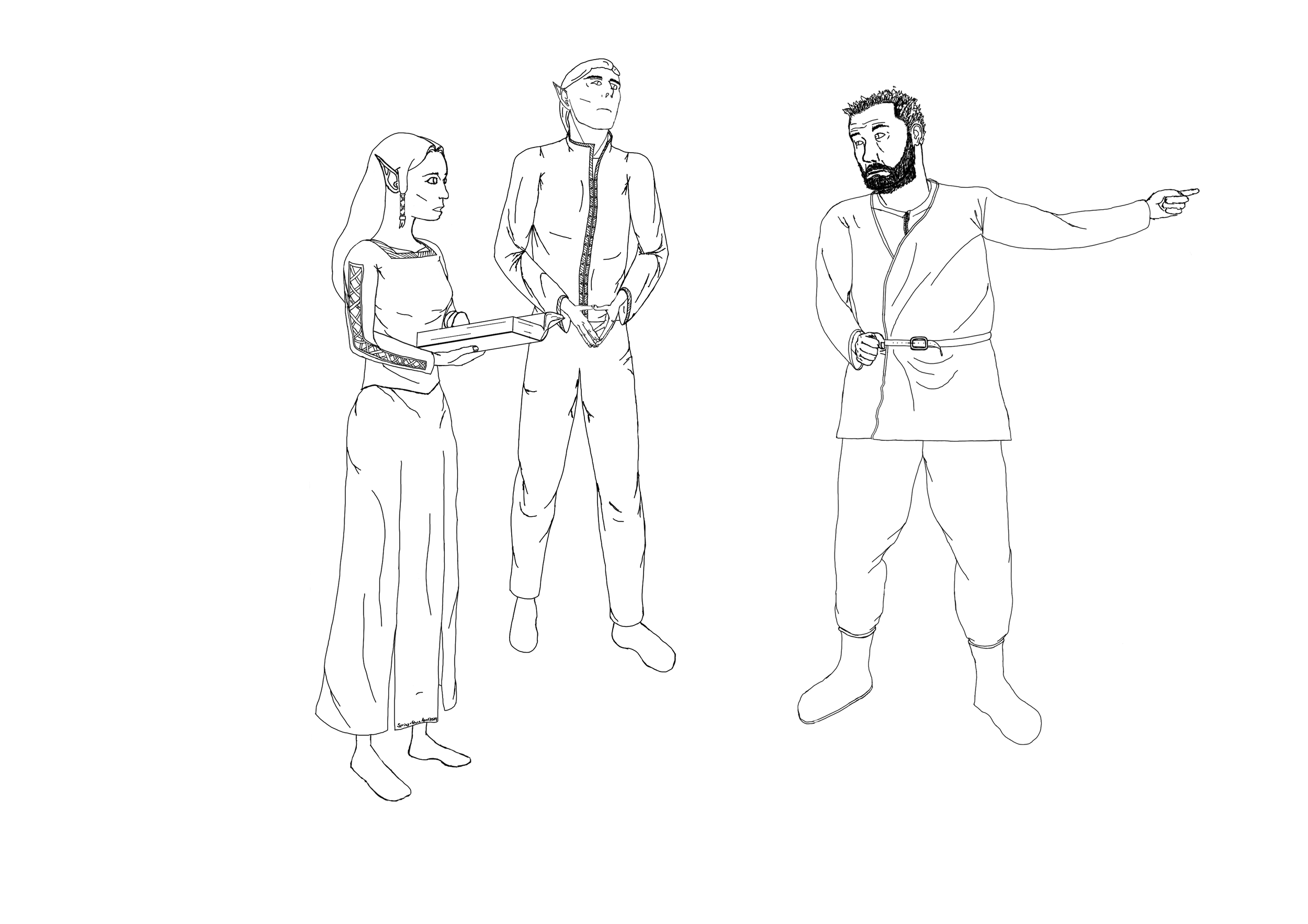
Elves arguing with a human
Overview
Elves are an ancient race of stunningly beautiful people with long lifespans, and seem immune to the effects of aging. They have a love of life, nature, scholastics and the arts, but they also have a highly bureaucratic and family-based society.
Physiology, Appearance, and Ethnicity
Elves are roughly the same height as humans, albeit on the tall side, with slender frames and lean musculature. They appear as beautiful humans with pointed ears, which are backswept, holding to the head more closely than goblinkind, with their side-protruding ears. They reach physical and mental adulthood at twenty-five years old and otherwise cease to age, living a seemingly endless life. Like all other creatures, accidents and sickness happen. The most common cause of death for elves are mundane accidents such as falling down stairs or from heights, workplace mishaps, and so forth. Naturally, in times of war, fighting, injuries, and post-injury infections take the lead for the causes of death.
Elven statures tend to build wiry strength rather than bulky strength and so many elves are stronger than they look. Elves can be just as strong as any human or even dwarf, but the bulk is much smaller (though still noticeable). Their movements are graceful, and their long fingers lend themselves well to a variety of practices ranging from artistry, fine work in metallurgy, music, or dexterity with arms.
Their hearing and eyesight are both excellent; they can see detail at great distances, especially in daylight, and have superior vision at night. Their night eyesight is strong because they have more light-receptor cells in their eyes than humans do. They do not possess the heat vision (also termed ‘heatsight’) that orcs and goblinkind do.
Though there is much intermixing, there are three classical ethnicities of elves: High Elves, Wood Elves, and Grey Elves. Dark Elves do not typically mix with other ethnicities.
High Elves have fair or pale skin. Their hair can be straight or wavy, in blond, shades of brown, black, and (rarely) copper red. Their eyes are blue, green, or hazel.
Wood Elves are often discernable because they are more likely to have wavy or even curly hair, though many have straight hair with colors ranging from blond to red. They have a healthier-looking fair or florid complexion and the most muscular of the elven physiques. Their eyes are most commonly green.
Grey Elves have a paler complexion and fine, straight hair that they tend to grow long. Their hair is either silver or pale gold, with eyes of amber or violet.
Dark Elves are elves stained to their very soul by magical crimes they committed against other elves and nature itself. They are instantly recognizable by their sheenless black skin, dark as a moonless night, and hair as white as untouched snow in the depths of winter, though not uncommonly in silver hues as well. The color of their eyes spans the gambit of other elven ethnicities, appearing in amber, violet, hazel, or blue. Their coloration is hereditary.
Fairly commonly, some Dark Elves have further altered their appearances from rituals which they have undergone or by utilizing charms and spells, oils, or other cosmetics. Examples of these alterations could include adding luster to their hair, or changing their eye color or shape. Certain bloodlines, or those that earn other forms of favour among the Dark Elves, are afforded an opportunity to partake in a bizarre and gruesome ritual which causes their irises and pupils to disappear, leaving them with entirely white eyes.
In other ways, Dark Elves are very similar to elves in the style of their fashion, language, lifespan, view of the world, and history.
While it is common for elves to have ancestry that blends the three primary ethnicities (excepting Dark Elven lineage), there are rare examples of elves procreating with non-elves, namely with humans. These offspring are not considered elves. The child, and sometimes the parent, are not allowed in the Elven Lands. These half-elves are similar in many ways to their elven parent. Their ears will be pointed, but not as much. Their vision or hearing may be quite strong, like their elven parent, unless they inherited those senses from their human parent.
Half-elves do show some signs of aging, but at a very slow rate. They still live very long lives, as their elven parents do, but will show aging equivalent to a human in their forties (the half-elf may be two centuries old by then, though). As these half-elves live a long time among non-elves, it is common that they will have children of their own with offspring of further diluted blood.
Culture and Economy
The advantage to elves’ long lives is that they have more time than any other people to work and study, learn things, and accomplish tasks for the betterment of society and all the lands. Because of this advantage, the elves clearly see not only where the other civilizations make mistakes, but also how to remedy the issues. Elves, generally, view that other races are lost in the darkness of their short lives and will benefit from their guidance and leadership.
Many elves, especially those who have traveled or performed other tasks on behalf of one of their governing councils view this as a noble obligation borne for the betterment of other peoples, and that no other race is suitable to the burden of leadership. Most elves also clearly understand that any other society will grow resentful at such treatment, so most elven actions to guide the other societies and peoples of Paeta are quite subtle and indirect.
What this implies is that elves respect age. The young respect the old, and the old understand that their experience entitles them to deference. Just as elves believe they know better (and often do) than other races, so too do older elves believe they know better than younger elves (and often do). It is uncommon, though not unheard of, for elves to go against the will of their families and superiors.
This manifests as familial and occupational elders plan the lives and careers of their children and subordinates, plotting out possible marriages and career choices for them. Elders have been living for several hundred years and often have correct perceptions of the situation. Arranged marriages and pre-planned careers are quite common among elves. The result is often harmonious, though there are occasions of disgruntlement and unhappiness.
The older an elf gets, the more they know better and the harder it is to convince them otherwise. Just as any person ages and sees a great many endeavors succeed and fail, elves develop deeper wisdom about things that will and will not work. Like any other reasonable person, elves do not want their friends, family, comrades, and partners to fail and tire of seeing it happen time after time. Older elves can become quite stubborn and argue on these points without end. Other senior elves understand that stoutly arguing has its place, but attempt to bend others to their will through great patience.
That said, it is not as if young elves have no choices at all. Elves begin their apprenticeships when they reach the earliest stages of adulthood at twenty-five years old, termed the ‘age of selection.’ They select a vocation from one of the Orders (see below) and apprentice with an accomplished elf in the field. If the work is to their liking, they petition to join the order. If they find they do not enjoy the work, they apprentice with a different order. While there is familial pressure to join one Order or another, it is still the young elf’s decision. Apprenticeships typically last for ten years each. It is also common for elves to marry other elves from within their Order.
Elves generally marry for life. The ritual of marriage among elves is carried on from their ancient traditions and meant to be surrounded in an aura of romance. The prospective couple must kiss three times throughout the courting period. Both prospective spouses must initiate at least one kiss. After the third kiss, they must consummate their marriage and present themselves to society, their families and peers, as married. No higher authority can annul that ritual; only the couple can dissolve their marriage, and though marriages do end, it is quite rare. More commonly, one of the spouses dies. Some widows remarry, while others choose not to. Either choice is common.
Elves are considered to have reached adulthood at twenty-five years of age, when their minds and bodies have fully grown and they are ready to embark upon centuries of work and learning. Though they are adults, they are ‘far less adult’ then the other elves who are centuries older than they are. Most other elves do not consider the young ones to truly be adults until they are at least a century old. Although elves can marry and attempt to have children as soon as they reach adulthood, it is highly frowned upon. Twenty-five is considered too young to marry for elves. Most elves do not marry until they are at least a century old and, typically, do not seriously attempt to have children for another century after that. Elves generally do not marry other elves with more than a century of age difference, as it is considered improper.
Young or old, most elves believe they know better than the shorter-lived races, at least on some level. One thing that elves apply this belief to is magic. Elves believe very strongly that, based on what humans have shown them in their varied histories, is that the purest intentions will be corrupted and the most beautiful tools of craft will be turned into weapons of war. Elves almost universally believe that humans, orcs, hobgoblins, and goblins absolutely must not come into possession and use of magic as they would inflict great misery on themselves and their neighbors and that, eventually, elves would have to directly intervene at great cost to themselves to restore equilibrium.
Elves practice a subtle religion that they refer to simply as ‘The Ways,’ meaning their way of life. There is no dedicated clergy. Each elf learns the ways in their childhood. They learn respect for their wise elders and that the death of every elf threatens society. Even elves that are on poor or hostile terms with each other will deeply mourn the death of the other. As it is so difficult to expand their population, every single life is precious, and every death hurts.
As one of the two races in Paeta that possess the knowledge of magic (the other being the dwarves), elves have interwoven its uses throughout their society. While they defend their homeland with magic when they must with weapons and armors magically tempered and sharpened, much of their magic goes into the rest of their lives and livelihoods. There are charms for nearly every task from cleaning and drying clothes, cooking, growing crops, and nearly any other task that must be done as part of a profession or maintaining a household.
The application is scattered. Knowing magical charms among elves is akin to knowing how to read among humans: some do and some do not. Most know a few charms to help with some tasks. A cobbler will know a charm to polish shoes quickly. A mason will know a spell to mix mortar at the proper ratios, keep it fresher for longer periods of time, or dry it quicker to shorten the curing time. There is such a wide myriad of applications for magic that few can really be said to be mages that actively study and practice book magic.
The Orders
All elves join one of the orders and devote themselves to a lifelong pursuit of work. Below are some brief descriptions of each of the orders.
● The Order of the Book, or the Blue Order: This order is devoted to scholastic pursuits. Magical scholarship and advancement is their primary purview, but so too are the studies of physical sciences, nature and all of its creatures and materials, weather and season, history, the other peoples of the land, and most anything else that can be studied. Members often wear blue tunics.
● The Order of War, also called the Order of the Sword and the Red Order: Not only are these the soldiers, weapon masters, and generals that lead the elven armies to victory, but also the scouts, spies, and meticulous planners that keep their armies informed and synchronized. Though monikered the Order of the Sword, its soldiers often choose other weapons, such as spears, bows, axes, and the like. Weapon masters have a special marking on their mastered weapon, among which the most common is an etched, inlaid, or enameled feathered wing that spreads over much of the weapon. The Red Order does have a few select magi for deployment to battlefields. It has been centuries since they were used, the councils fearing that the use of magic against their foes, be they human, orc, goblinkind, or what have you, will reignite the idea of magic among them and induce them to seek it out on their own after the conflict. They commonly wear red tunics to honor the blood spilt in the past in defense of the elven people.
● The Order of the Harvest, or the Green Order: These are the farmers, shepherds, goatherders, apiarists, vintners, and every other contributor to agriculture. They produce the food materials for the rest of elven society. Members often wear green tunics or some other form of clothing.
● The Order of the Sun and Moon: This order is comprised of the craftsmen and artists of elven society, from sculptors and painters to masons, cobblers, and smiths of all types.
● The Order of Trade, or the Black Order: They are the merchants and are a critical link between the labors of the other orders. Merchants are most likely to travel outside of the Elven Lands apart from business on behalf of the Order of the People. They also manage the trading posts at the borders of the Elven Lands where humans sometimes trade with elves. Black is their chosen color because it is the most difficult to dye and maintain and, therefore, makes it the most expensive. Merchants often wear at least some piece of clothing that is black, even if not their tunics or dress, when within the Elven Lands.
● The Order of Peace, or the White Order: This order is comprised of the diplomats of the elves. Wearing white tunics, they mirror the Blue Order in some ways in that they spend much of their time studying the other races and realms, even the ones to whom they are hostile, gathering information and forming an understanding of how the other actor thinks and acts. The Order of Peace is a critical instrument for informing the decisions of several other orders.
● The Order of the People, also called the Order of the People’s Will, the Order of the Will, the Purple Order, or simply, the Will: This order is the governing body of the elves. They form a variety of councils on various matters, both large and small. Their members are drawn from the other orders based on appointments, nominations, and petitions. Admittance to the Purple Order is quite prestigious as it symbolizes that an elf is among the top of their chosen field. Members of the Purple Order retain membership in their original order and wear both colors.
Governing Bodies and Societal Organization
The two most prominent councils are the Guardian Council and the Seer Council. The Guardian Council is entrusted with the protection of the Elven Lands and its people. It has the authority to mobilize fighting units, appoint leaders, and create major movements or resources to accomplish goals related to safeguarding the people.
The Seer Council is responsible for understanding the lands and peoples around the elven homeland and advising the Guardian Council and other councils on the state of current affairs in foreign lands and their anticipated trajectory. The Seer Council is limited, however, in its ability to gather new information, as its authority limits it to study, scrying, and other methods that do not involve travel outside of the homeland.
The Seer Council is reliant on the Guardian Council for gathering new information and does so through Travelers. The Seer Council identifies the need for Travelers and defines pieces of information that need to be learned or updated on the trip, but the Guardian Council validates the requirement and assembles travelers.
Language
Elves speak Elven. There are several dialects of Elven, which largely vary by settlement or vocation, though all dialects are understood by one another’s speakers. The distinction of dialects is largely accent and manner of sentence construction. The most distinctly different from other dialects is the dialect of the elves of Ebariel, where Tyrnimar Iquarren and Irduin Usrani are from, in which their sentences are structured in the passive voice.
Cities and Architecture
Juin is the capital of the Elven Lands where the councils administer the rest of society. It is a city that blends the two main types of elven architecture: woodwarping and masonry. Woodwarping, also called Woodshaping or Woodsinging, is a collection of book magic spells and charms that interact with the wood itself and allow the Woodwarper to obtain agreement from the wood to reshape itself. In many cases, this is used in place of carpentry. Buildings made with woodwarping are most often great trees that grow to immense heights and thicknesses, which is part of the preparatory stages of woodwarping, before cavities are formed for stairs, rooms, chimneys, and other architectural features. Hallways and walkways are formed through the wood. Dwellings and business locations for many elves can reside in a single great tree, almost forming a village unto itself.
The other form is comparatively mundane: masonry. It is as it sounds. Elves never developed the close connection with stone that they have with wood, as they find stones too argumentative. Despite this, their stone structures are beautiful, with flowing lines that efficiently meet functional needs. Stone, brick, and mortar form graceful arches and spacious interiors for all manner of structures. Some cities and towns contain more of one type of architecture than the other; Ebariel, for instance, is mostly a masoned city. Some villages and hamlets consist of only one or two great trees with the entire village’s dwellings shaped into the trees and no other structures.
Non-elves are not permitted inside the Elven Lands and will never know the beauty of these sights.
Arms and Armor
Elves favor the grace and elegance of the sword and the bow. For swords, they prefer longer, single-edged two-handed swords with slightly curving blades and flowing crossguards. Several spells and charms are used in the forging, tempering, and sharpening of these blades, making them able to defeat armors that other blades cannot. The arcs and flow of swordwork lends itself to the elven form and their general aesthetic preferences, though there are plenty of elves that choose spears, axes, or other weapons over the sword. Weaponmasters carry blades marked with an engraving, etching, inlaying, embossing, or enameling of a bird’s wing spread over the length of the blade.
The longbow is preferred by most elves of the Red Order for its balance of range and power with speed. The exception is with mounted archers, whom elves will put to field, who use shortbows made of a composite of different materials laminated together.
Many of the Red Order train to fight from the mount as well as on foot. Most warriors have trained at least a bit in every aspect, given that decades are a short time to them, compared to human career soldiers whose entire fighting career might be less than three or even two decades.
Enabled by the ready hands of the Order of the Sun and Moon, elves benefit from extremely light and strong alloys of steel, also enduring several enchantments for their strength and durability. Elves will commonly wear a suit of light mail with plates over joints and some vital areas. Some elves will take the field in a full suit of plate, but this still is the lighter elven plate, stronger than most human alloys.