
Goblins
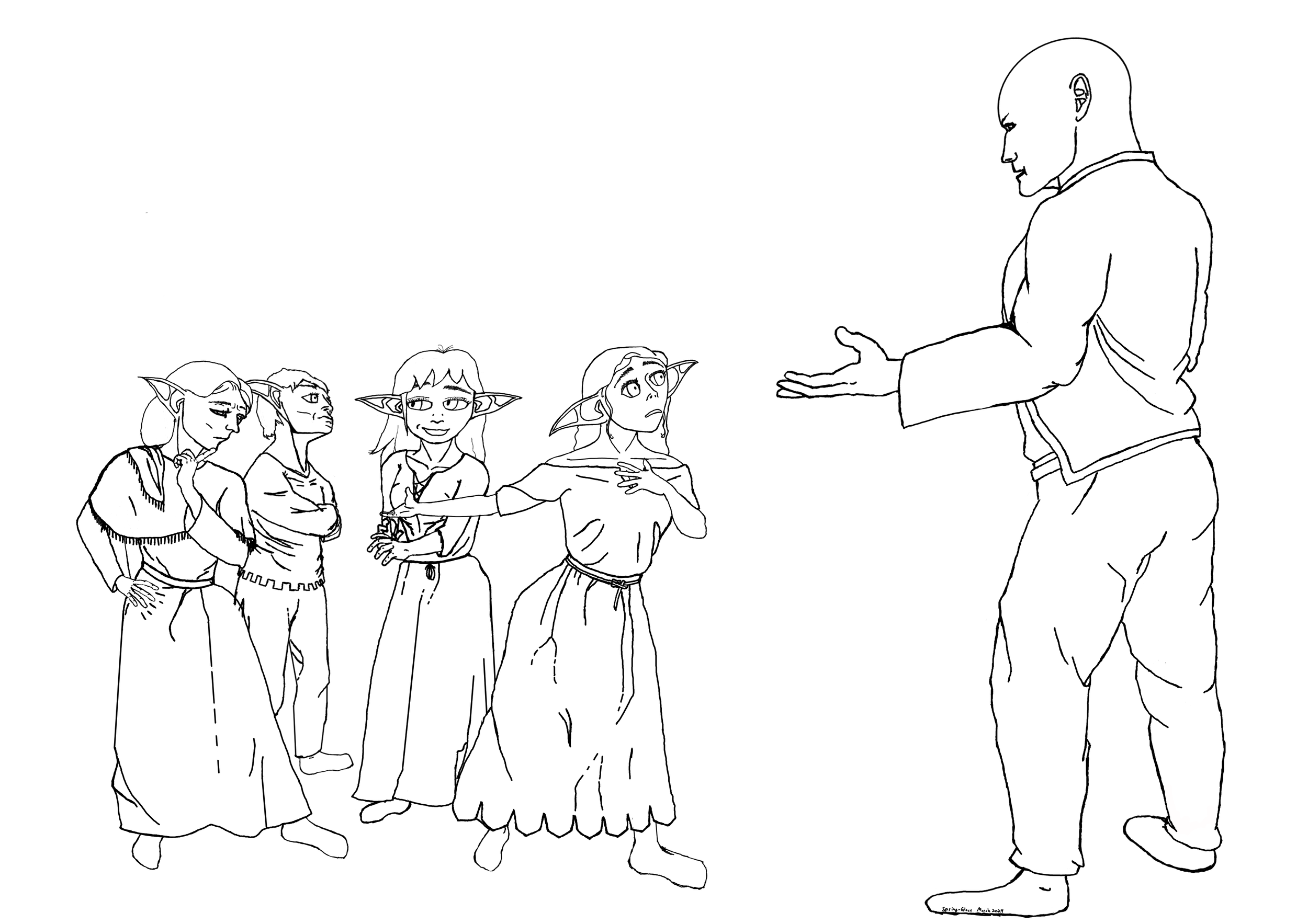
Goblins arguing with a human
Overview
Goblins are among the ‘cast-out’ races and the most urbanite of three races of goblinkind. They are clannish, pragmatic, and builders in most everything they do. They have the most well-rounded view on life of all the cast out races, lacking hobgoblins’ driving need to compete and dominate, and the bugbears’ strong preference for solitude. Physically, they are the smallest and weakest of goblinkind and thus acutely know that what strength they have lies in cunning, subtlety, and numbers. They have a largely egalitarian, tribe- and clan-based society.
Physiology, Appearance, and Ethnicity
Goblins have a natural lifespan of approximately seventy-five years and reach physical adulthood at eighteen years of age. Depending on the tribe or clan, a goblin may be considered to reach societal adulthood and breeding age between fourteen and eighteen years. They generally fluctuate around three feet in height with common variation of a half-foot taller or shorter. There are instances of taller and shorter goblins, but they are very rare and may be a result of mixed lineage with non-goblins.
Their proportions seem like a half-sized adult human, at first glance. However, with a moment’s examination, one notices that goblins have heads that are proportionally large for their bodies–shorter and wider, compared to the proportions of a human head. Their eyes are large for their already disproportionately large heads. Their ears are also quite large, protrude mostly to the side, and taper into points. They have excellent hearing through these ears, albeit heavily biased in the direction their head is facing.
Like most other cast out races, they evolved a different type of cell in their eyes that allows them to see in the infrared bands of light, sometimes called ‘heatsight.’ Effectively, when there is insufficient light for chromatic vision, they see infrared in greyscale where higher temperatures are brighter, allowing them to see in darkness. This is generally only when chromatic vision fails, but their infrared vision can take over when very hot objects are in their field of view. The infrared vision also grants some advantages in metal-working.
Similar to hobgoblins, goblin ethnicities come in four main distinctions by skin color: blue, purple, red, and gray.
Blue-skinned goblins are predominantly from the slopes and caverns of the Western Kaskev Mountains and built the great city of Kogylar. They have hair that is black most commonly, though shades to blue, green, purple, brown and gray are not uncommon. Sun-bleaching is a factor. Their eyes are typically black, though violet, gray, purple, blue, amber, green, silver, red, and brown-colored eyes are common enough.
Purple-skinned goblins hail mainly from the Eastern Kaskevs. Their hair is largely shades of gray. Black hair is also common, as are shades of dark blue (lighter shades are less common, as is purple). Sun-bleaching hair is a strong factor for purple-skinned goblins. Instances of silver or golden blond hair are recorded but not seen in recent times. Their eyes are usually amber, green, or yellow-green, with violet, purple, blue, or red being less common.
Red-skinned goblins are generally from the slopes and caverns of the Western and Northern Kaskev Mountains. The red-skins tend to be taller than the other ethnicities. Their hair is black or shades of gray, though darker shades are more common. Their eyes are light gray, dark gray, silver, black, blue, violet, or red. Amber eyes are rare, and green eyes even more so.
Gray-skinned goblins dwell in the east and south of the Kaskev Mountains. Their hair is usually black, though shades to blue, green, purple, brown and gray are not uncommon. Sun-bleaching is a factor, but less so for gray-skins because their hair tends to be thicker than the hair of other ethnicities.
Most goblins breed within the same ethnicity, but settlements with large amounts of trade or near other ethnicities’ settlements do see ethnic mixing, which affects coloring. In some instances, there may be tinges of green in their coloring, which implies orcish blood in their lineage.
Goblins do not suffer the stunted fertility of the larger goblinkind. The goblin gestation period is nine months. If the coupling is mixed, then it varies.
Culture and Tribal Construct
Goblins recognize their physical and social place among goblinkind. Knowing that they are at risk for being at the mercy of those bigger than themselves and never forging friendly relations with other races of their size, such as the kobolds or dwarves, they embraced survival as a key to their culture. Much of what they do, directly or indirectly, is for the survival of their race, their tribe, their clan, and themselves.
To ensure their survival, goblins formed a society of tribes made up of clans. The clans are effectively group families or group marriages, and maintain established rules of conduct that generally govern their behavior. These rules vary from tribe to tribe, city to city, even clan to clan. Sometimes they are written in hard code, and sometimes they are known and unspoken or even such basic assumptions of their view that they do not even notice to acknowledge them.
The tribes are led by a great one, who, like other cast-out races, has distinguished themselves through some great deed. They have an egalitarian society, and the sex of a goblin is no bar to station. Unlike the other cast-out races, a great deed among goblins need not be one of war, conquest, or violence (though it is not exclusionary). Goblins have earned names among their own kind for founding and building cities or mines, inventing new technology, building bridges and dams. In ancient times, when goblins still had wizards of their own, many of them were named for the discoveries and miracles they wrought.
As with the other cast-out races, as life is usually short, and sometimes violent and cheap, names must be earned. If a goblin has not accomplished a great feat, then they are not worth remembering.
Values that are mostly commonly held by goblins are a sense of pragmatism, cunning, and farsightedness, a sense of propriety and respect for the rules that have kept them alive. What balances them most among the other goblinkind is that they seek to enjoy the lives they have. They can be mischievous and joyful, and enjoy music, food, and love.
They are not stricken with the curse of stunted fertility like the other goblinkind. Though they are not as fertile as orcs, they use the comparative advantage of fertility over their larger cousins and the advantage of their general demeanor over that of the orcs to out-populate and out-build the other cast-out races.
While most of this implies that goblins are peaceful, they have suffered a long history of abuse at the hands of many others, be they were orcs, humans, elves, other goblinoids, or even other goblin tribes competing for territory and resources. Goblins fight with great cunning and ferocity, as they believe that every conflict is a struggle for survival, or else will lead to a struggle for survival. An aspect of their pragmatism and farsight is the view that conflict is inevitable, and they prepare for it accordingly.
They have a culture of low-waste. They do not believe in infanticide, as every single body can contribute to the survival of the tribe. Every material goes to use. This is apparent with their use of the remains of livestock. After the meat is taken for eating, every other material is used. Skin for leather, fur and hairs for textiles (woven fabrics or yarn), sinews for cord and string, bones for tools or tool grips, fat for food preservation, cooking, or skin softening: everything goes to use. This is even the case for clan members. As one last contribution to the well-being of the clan, the remains of their deceased are used for all things practical.
Goblins have a fascination with their dominant cousins, the hobgoblins. They admire their strength, resolve, and ambition to the point of imitating some aspects of it. Some goblins or whole clans devote themselves to martial pursuits, but the most conspicuous imitation of hobgoblin culture is ritualistic cannibalism. After the hobgoblins’ custom, cannibalism is practiced to honor a fallen family member or comrade, or to purge weakness.
Family, Fertility, and Property
Goblin families are a group marriage. Children of both sexes are raised under group parenting to adulthood (which varies between tribes and regions) and then given to other families to ensure genetic diversity. Inbreeding is strongly frowned upon and incredible care is taken to avoid breeding with cousins. The clan/family unit chooses another family within the same tribe to whom to give the young adult, based on their assessment of how well the young adult will live, and the personal relationships formed with other families during childhood. In times of hardship or in the rare cases of rural, nomadic, or semi-nomadic clans and families, survival and necessity govern the decision of to which families the young adults are sent, rather than preference and personal relationships.
It is uncommon, but not rare, that tribes will exchange young adults for genetic diversity outside of the tribe. This is generally on a consensual basis, and predicated upon the two tribes having good relations and neither competing for resources nor dominance in an area (which is why it is uncommon).
Different clans and tribes of goblins differ in the nuances of these practices. For example, some clans perpetuate trades within the same families for generations and generations, continually gaining new adult members from other clans (or even tribes) and marrying off their young to other clans and tribes, maintaining genetic diversity among the clans. In a few cases of powerful urban families, they take a family name within the named clan or tribe. Other practices differ: for instance, all breeders within a family unit are generally the same age, within four to five years. Instead of continuing the same families with new breeding members, new families are often formed, most commonly when a newly-of-breeding-age young adult is three or more years younger than any member of any existing families in the clan or tribe.
Larger families are considered to be more prosperous and prestigious. This translates into tangible terms: larger families having more working adults and need larger dwellings. Most of the possessions of the clan are shared through the whole clan, with common exceptions of favorite clothes, vocation-specific tools, musical instruments and the like.
Goblins do take slaves, though not other goblins. Goblins captured during conflict with another tribe join the capturing tribe, often never seeing their original family again (save those with whom they were captured). Those joining another tribe are often at a disadvantage and have few choices as to which clans are willing to take them.
Among the adults in a clan, everyone is married to everyone, and are usually polyamorous within the clan. In cases where one goblin within a clan finds another distasteful as a romantic partner, they often adopt each other as siblings and do not breed with each other. That said, goblins joining a family must give and receive love from every breeding adult within the family. Sex tends to be playful and relatively public, within the clan’s dwelling. It is common for some adults to engage in group sex while others cook, clean, work, sleep, watch, or play music. Privacy is not much of a concern within the clan.
With respect to non-clan members, goblins become very reserved. They do not display sexual activity to non-clan members, as they view it as improper behavior. Sexual activity with a non-clan member is exceptionally reviled, a transgression on the same level as murder, and often grounds for expulsion from the clan. Only in rare and extreme circumstances will the bounds of propriety allow for these rules to be bent or broken.
Slaves may be included in sexual activity amongst themselves, but goblins will not breed with slaves to the same degree that they will not engage in sexual activity outside of the clan. Any offspring from intercourse with a non-clan member or a slave would be condemned by the clan. The child may suffer poor treatment and choose (and be urged) to leave at the soonest opportunity. In many cases, these unfortunate offspring must form their own clans, which no proper goblin would wish to join, generally only being able to take other goblins in similar situations.
These honor-stained clans occupy the lowest social standing within the tribe or settlement. When there are multiple tribes within the same settlement, such as the city of Kogylar, there is generally only one or two of these clans. They often bear disproportionately heavy burdens within the tribe, taking on unprestigious jobs and vocations. In many cases, they leave the settlement altogether and join goblin enclaves in other racial settlements as part of the small goblin diaspora.
Hygiene and Fashion
Goblins routinely bathe themselves and clean their dwellings, especially in the city where there is large risk for the smell of what waste they allow themselves. They make soaps from the fats of livestock or their own deceased. Wealthier clans use fats for skin softening.
Jewelry is a common staple, especially among urban goblins. Nose rings, earrings (usually multiple in each ear) are very common. Nipple, navel, and other piercings are also common, as is tattooing, which tends to focus on floral or geometric designs.
Goblins craft garments from leather, furs, textiles from animal hairs. This includes their own hairs from their head and bodies being woven into yarn or fabric. From these, goblin clothing takes the form of trousers, long dresses, long skirts, shirts, coats, gloves, aprons, and any other needed garment. Goblins commonly knit shawls, scarfs, gloves, hats, and other garments. Men wear trousers. Women wear dresses, skirts, or trousers. Women wear trousers if they answer a muster call for war. Plant-based fibers and fabrics are in short supply and not common among goblin clothing.
Music
Most goblin music centers around what they call a strummer (sitar), a set of prongs (marimba), and a drum or set of drums. These instruments are usually played in bands of three to five, with multiples of some instruments, especially drums. Solo strummers, prongs, or drums can also be played, but most music is enjoyed with the instruments played together. Most clans have a few players and they will routinely play during meals or love-making.
Language
There are many dialects of Goblin that generally center around the nearest city (for example, the Kogylar dialect). All dialects use the same set of symbols for phonetically written Goblin, but different dialects have varied words and accents. Goblins from relatively nearby goblin settlements, for example, the next largest goblin city, would probably be able to understand most of what a Kogylar goblin is trying to communicate, but one from far to the south, north, or deep underground, would not. Ancient Goblin was written in runes.
Hobgoblins and bugbears also speak Goblin as their own tongue, but may have their own dialects. They use the same alphabet as the Goblin language.
Cities and Architecture
Due to the restrictive nature of mountainous terrain, goblins became excellent masons, approaching a rival status with the dwarves, and built into mountains and hills. Like humans, they build up, but like dwarves, they also build down. They consider maximizing the full potential of the land to accommodate structures and functionality, and view inefficient use of the land to be distasteful and foolish. There are few orc cities, but the goblins look down upon their construction the most for its inefficiency and poor form.
They can admire human cities for their form and function, but still consider them limited. Only dwarven masonry causes them to stop and sigh, but even then, goblin and dwarf masons, if they could be on speaking terms, would have a difference of opinion. Even still, in terms of the skill with which they work stone and timber, goblins struggle to reach the level of dwarves simply by the difference in their lifespans. While goblins have a lifespan comparable to humans, dwarves have lifespans two to four times longer.
Goblins usually build cities and other settlements near surface or subsurface water sources. They dig and fill the terrain to divert and enhance water flow, providing constant recirculation. In the case of underground water sources, which is one of the very significant reasons which they build downward, they build mechanisms to carry or divert water to a higher reservoir and provide for the upper levels of the settlement.
More sophisticated cities will create water systems that provide individual domiciles with their own water intake and outtake through ducted or masoned water diversion. Generally, this takes the form of a small portion of a river or stream’s flow, freely coursing through a duct or trough in the domicile.
Generally, domiciles on the lower levels of the settlement are considered more prestigious because there is more access to soil for growing roots, the soil is more fertile, the air is moist for mushroom and other fungus growth, and the low light is permissive for types of mushrooms to grow that cannot grow on higher levels. Additional assets are a closer proximity to water, and the availability to expand a domicile by building further down.
Food and Drink
Goblins grow crops and raise livestock like any other race that supports city-bound population, but they are constrained to species that survive in the austere mountains or underground caverns. They keep sheep, goats, hogs, and pigeons for livestock and grow a variety of crops, but largely roots, tubers, and mushrooms. They gather eggs from the pigeons and only use the pigeons for meat if they die, or can no longer lay or fertilize eggs. Goblins gather dairy from sheep and goats, but as they are a no-waste society, will also gather and use their own dairy within their respective clans. There is also a foraging industry for mountain herbs, surface mushrooms, berries, and bird eggs in addition to hunting and trapping.
They bake, but since they cannot grow wheat in the mountains, they use ground and dried root vegetable powder in its place. They prepare a wide variety of dishes with a stronger emphasis on soups and stews in the colder months. Some tribes also make noodles or dumplings from root vegetable flour in varying ways.
They bake bread, cakes, and pastries. They have a strong sugar industry from processing beets, one of their root vegetable crops. With a robust sugar industry, they also produce other confections, such as caramel. Caramels, in particular, are usually prepared as a special family dish.
They drink boiled water, tea from mountain herbs and flowers, and small amounts of mountain berry juices and wines. They prepare a drink from fermented birch bark or birch root, heated and mixed with honey, called birch beer. Birch beer is more common in southern goblin settlements, but the taste for it has spread to most other goblin cities and the unprocessed birch bark is among the many imports from southern settlements.
Goblins, modeling after the example of hobgoblins, also distill their own ridin from potatoes, beets, carrots, or mushrooms. Though goblins have a wide variety of drinks available, anything but boiled water and some teas are limited due to the space to grow or forage the stock for it. Less urban communities that tend to have less ready access to water immediately in their domicile and either have the space to grow and forage the stock or the lower population that will consume less tend to have wider drink varieties. Wealthier urban goblin clans tend to have wider selections of drink, as well.
As goblins have a no-waste mentality, poorly prepared food and drink is still eaten unless there is a risk to health.
Organization for War
Like hobgoblins, goblins have an egalitarian society. Men and women can answer the call for war. Goblins, being physically smaller and weaker, prefer to choose the circumstances of fighting in which they can use their cunning, large numbers, and element of surprise to their advantage.
Warparty: Four to thirty soldiers from the same clan, usually led by the clan leader. Typically, the warparty is not the whole clan, as leaving some adults to care for the hearth and the young is important.
Serpent: Concept that organizes soldiers into groups of thirty soldiers or less, usually breaking a warparty into several serpents to perform a specific task, usually scouting, infiltration, or raids.
Warband: Sixty to two hundred soldiers from various clans. So that the clans survive a defeat, warbands are led by a goblin selected by the tribe’s great one or an acknowledged soldier or leader. These groups are self-sufficient and usually able to function as infantry and archers; only some tribes can provide specialized sappers.
Fist: Two hundred to one thousand soldiers, led by an acknowledged soldier or leader that has also been picked by the tribe’s great one.
Host: Several thousand soldiers led by the tribe’s great one.
Note: Goblin clans plan their pregnancies in advance and ensure that, if called upon, no more than half of the family goes to war. There are always enough females and males remaining at the hearth to care for children, raise the young, maintain the home, and provide for their welfare and prosperity.