Humans
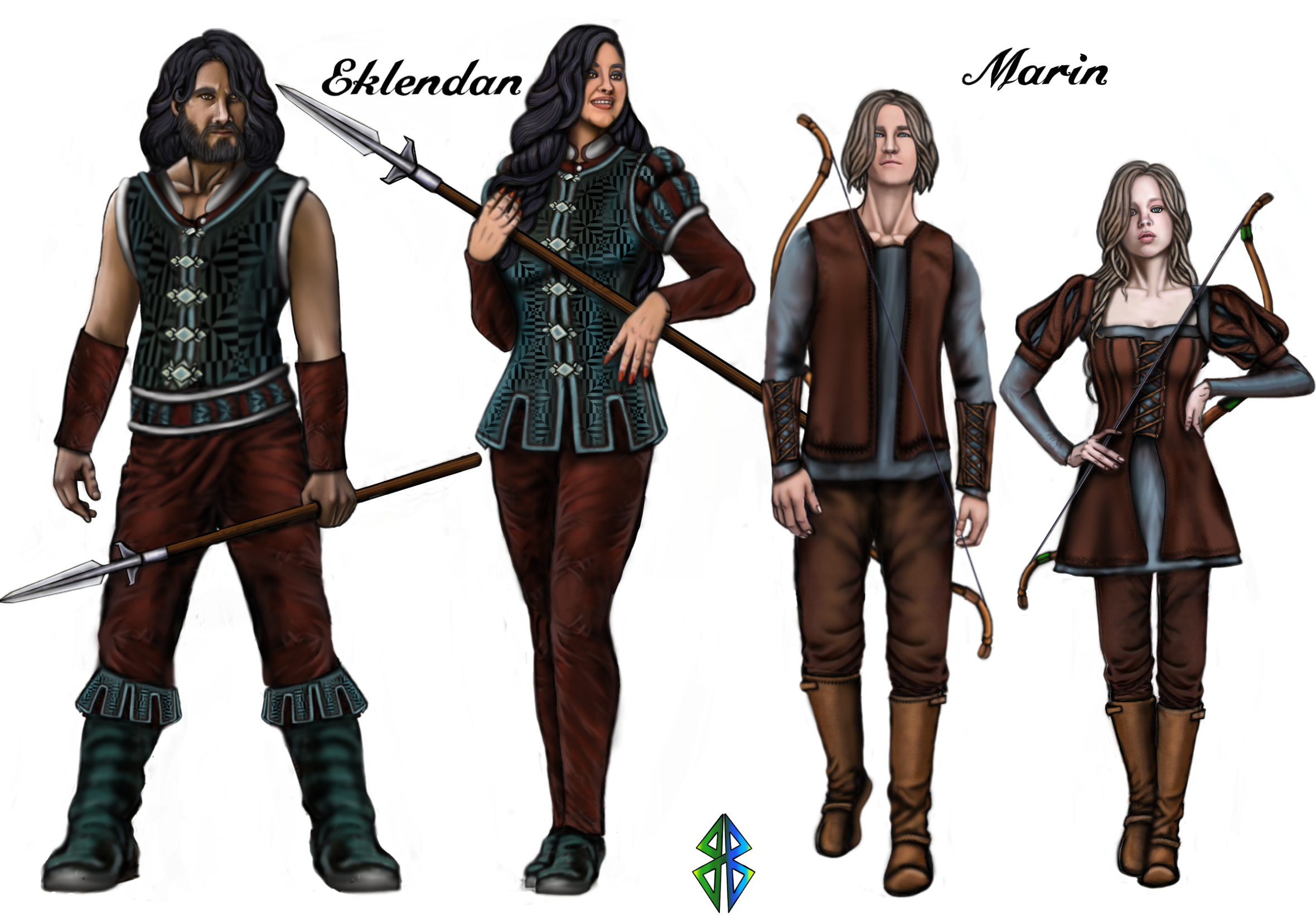
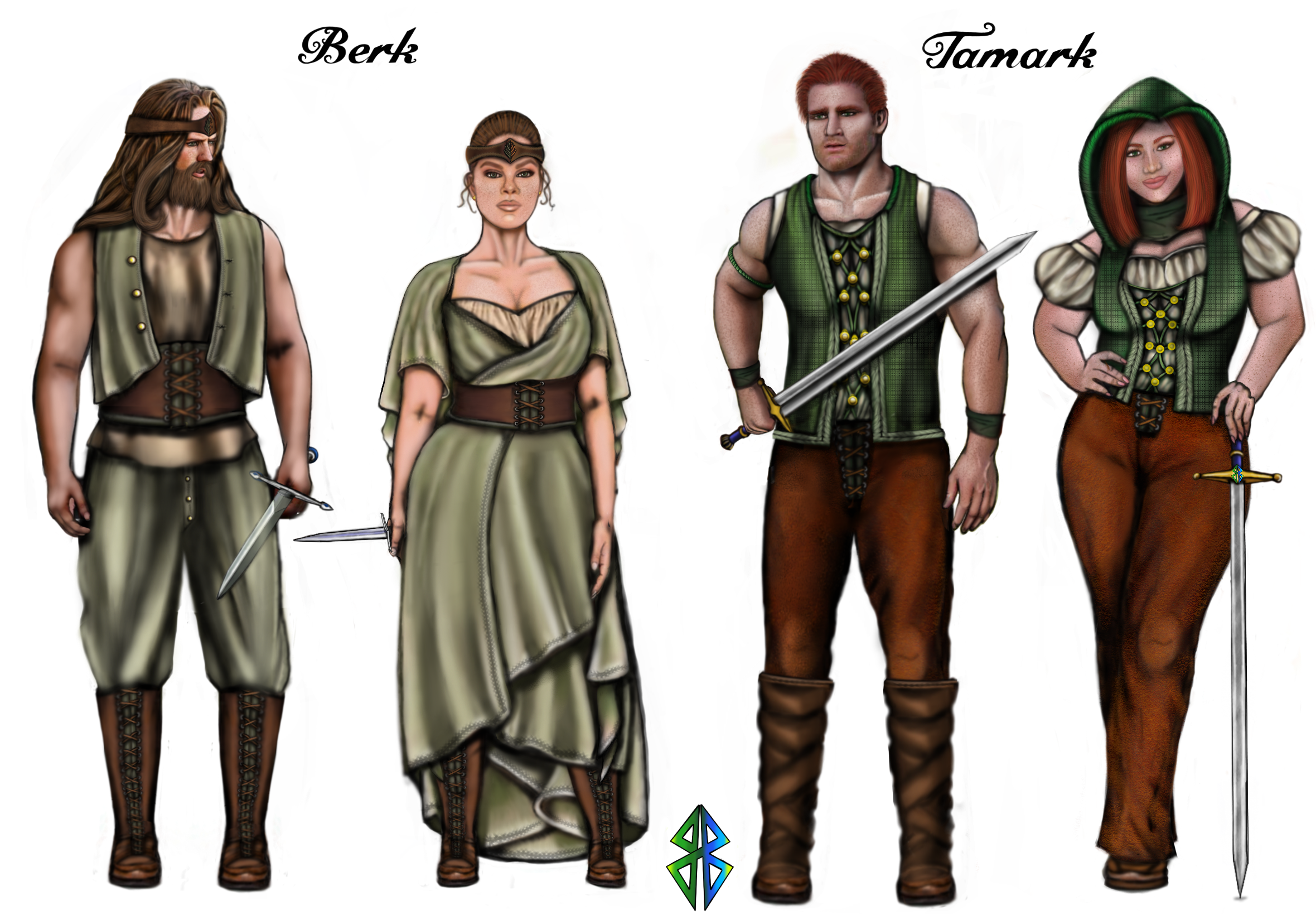
Humans of Western Paeta, by ethnicity
Overview
Humans are the most abundant and dominant of the sentient races of the land. They balance many qualities that other sentient races take to the extreme, at least within their cultures. Their ethnicities are widely varied throughout Paeta and the other continents.
Physiology, Appearance, and Ethnicity
Humans have diverse ethnicities but, more or less, look like humans as we know them. There are, of course, subtle differences between the ethnicities. The following are the ethnicities in Western Paeta, but this is not representative of all the ethnicities of Paeta or the other continents. Especially in Gersh, ethnic interbreeding has been commonplace for centuries. In the cases of mixed bloodlines, the traits intermingle and blend.
Marins, from Markia and Northern Gersh, tend to have light frames and are shorter in stature than most westerners. Their skin is fair to pale, with blue or brown eyes and brown or blond hair, though there are exceptions to these norms. They tend to have narrow noses. Their spoken language is Marin and the common suffix for their surname is ‘-ail’.
Berks are from Berkmar and northwestern Gersh. They have fair or ruddy skin and may have facial freckles. Some will have whole-body freckles, but this is uncommon. Berks tend to have blue, hazel or green eyes with blond, brown, or red hair. Their builds tend to be heavier, with broader shoulders, hips, and jaws than most, but there are plenty of moderate frames among the Berks. They speak Berk and mark their surnames with the suffix ‘-ifar.’
Tamarks are from Tamarkand and western Gersh. They generally have florid, ruddy complexions with blue or green eyes and blond, brown, or red hair. Their frames are often of a medium build, but many also have a barrel-chested, thicker build, and can appear similar to those of Berk descent; unlike Berks, however, Tamarks have a very high occurrence of facial and whole-body freckles and tend to be narrower in the shoulder. They speak Tamark, which has a separate alphabet from the other western languages.
Eklendans, from Eklenda and southern Gersh, tend to have medium to light olive skin. Most commonly, they have medium to thin builds, narrow jaws, tend on the taller side for Westerners. Their hair is brown, black, or red hair with light or dark brown eyes. Eklendan is their spoken language. The common Eklendan surname suffix in Gersh is ‘-dran,’ with uncommon instances of ‘-avan.’ The latter suffix is more common within the Kingdom of Eklenda.
The old Paetic language from the days of the Paetic Empire had a different alphabet based on its eastern influences and looks largely different from western alphabets, though there was some influence on the western alphabets during imperial rule.
Culture and Economy
The Gershan peoples are unlike their ethnic counterparts in the coastal realms. There are divisions and distrust between the various ethnicities, but within Gersh, it is more a character of city against city, rather than people against people. Because the Gershan Lands are a confluence of different ethnic groups centered around princely cities, Eklendans and Marins from Yvel are more likely to get along with each other than their ethnic cousins from the cities of Soorin or Versingit, let alone from Eklenda or Markia.
Marin humans, especially ones from Markia, are used to long and cold winters. They have a practical and pragmatic way of life that reflects living with one eye always fixed on the coming of the next cold season. They tend towards the more stoic side and can come across to others as callous. Marins generally do not pronounce vendettas or engage in theatrics (though there are exceptions to every rule), but they do hold grudges, have no appetite for waste, and do not give up on anything lightly.
Berks, ironically, are the closest to the Western Church of Orneth, but are also the closest of all the western Paetan traditions that predate imperial rule. They still commonly decide legal disputes through trial by combat, which largely died out in other regions. Physical strength is considered respectable and attractive among Berks and they have many sports for the display of it, especially among commonfolk. Berks also respect their elders (both in terms of age and seniority) and will defer to older members of their own group, such as a family, a group of merchants, or a religious order.
Tamarks tend to be a kind and warm people. They very much believe that the nobility of their lands and the laws they make are there to protect the common people. This is a belief held by both the commonfolk and the nobility, who will use this belief to explain away and dismiss situations or justify actions. Tamarks are a prosperous people that benefit from trade, both overseas and inland, through land and river trade routes. They greet one another with warm smiles and hugs, and easily share meals with strangers.
Eklendans have a strong respect for custom and decorum, and can be sticklers for propriety and tradition. As such, they have a polite set of manners and smiles for the sake of courtesy. Behind the smile may be genuine benevolence, tired courtesy, or an ulterior motive. Eklendan upper society can be socially ruthless, especially for those not aligned to a powerful figure. Non-Eklendans know some Eklendans (particularly those from Eklenda) as cunning, subversive, and occasionally greedy. Eklenda has a history of producing notorious and storied spies.
The vast majority of humans worship Orneth and her Saints, and consistently attend religious services. In Western Paeta, the majority of clergy members are ethnic Berks from Clovis or southern Berkmar. Clergy members are the most educated members of society, at least in terms of formal education. There are no other universities in Western Paeta besides the Holy University at Clovis. Some humans may spend significant time in self-study, but it is not formal education and will be viewed as such by graduates of the university.
A point worth noting is that not all graduates of the university are clergy members. Wealthy noble families often send their youth to Clovis for a few years of education. For most other folk, most nobles know how to read, write, and arithmetic while commoners have a much lower instance of being fully literate. Most commoners will know enough arithmetic for trade and to manage their occupation.
West of Kaskevs, most common folk are born free, though slavery is practiced in most realms west of the Kaskevs with varying levels of societal attitudes towards it. Common folk, for the most part, are free to take on any trade or enterprise and own property, if they have the means to do so. Farming and livestock raising and related or supporting activities are, by far, the most common vocations among humans anywhere, followed by various industries, fishing, hunting and trapping, mining, transportation/trade, and military occupations. Sex is not a discriminator to occupation or station in western Paeta. Men and women equally hold office, own property, fight under banners, crew ships, suffer punishments, and so forth.
Every town, village, hamlet or farmstead falls within the domain of one noble or another, whether or not their manor is nearby. These nobles may tax and levy commoners (and even other nobles operating enterprises within their domain) at their discretion.
In most of Gersh, trade and travel are by road, either on foot, horseback, or drawn cart. Rivers do support trade and transportation into the larger lakes and outward to the seaports in the coastal realms where cargo is transloaded for shipment over the sea. Rivers closer to the Kaskevs quickly become too shallow for ships. Barges and rafts are used, where feasible, but they quickly become either obstacles for travel or sources of water, fishing, and some minerals.
Fashion
Most humans prefer to wear varied colors, unless their occupation calls for otherwise. Dyes are common enough from local fauna. Most towns of sufficient size weave their own fabrics and make their own dyes from a variety of sources, be they berries, wood, leaves, local minerals, vermin (bugs or snails), and other organic materials. Some colors are limited (or available in abundance) by the availability of certain materials.
The clothing itself is largely based on local materials. For the most part, southern Paeta clothes itself largely in cottons and linens, saving wool for winter clothing and blankets, and leather for work clothes. Northern Paetans favor wool clothing for larger portions of the year, wearing scarves for much of it, and donning furs or fur-lined clothing for the winter.
Jewelry is largely limited, due to societal norms, to pairs of matching earrings on women or men, generally no more than one earring per ear, and some rings. The most common ring is a wedding ring, worn on the third finger of the left hand. Tattooing is fairly common in Paeta.
Shoes and boots are commonly worn and usually made of leather. In colder areas, they are lined with wool or fur. In warmer areas, such as the coffee or rice fields of southern Paeta, leather or wooden sandals are worn as often as shoes or boots.
Music
Musical tastes and instruments vary by ethnicity and social station, but popular instruments among many human cultures are the fiddle (particularly amongst the commoners), recorder (or flute), and various forms of drums and guitars. Guitars, frequently accompanied singing by the guitarist or another singer, are more popular in southern areas of Paeta, believed to either be developed there or brought by traders from the far-off land of Ungat. Drums, fiddles, and singing are more popular in the northern areas of Paeta. Harps are more common on the eastern side of the Kaskev Mountains (moreso closer to Mardalon), and very rare in the west.
Food and Drink
While examples of common foods by ethnicity and realm are listed here, this is far from an all-inclusive list. Excepting coffee (see note below), foods are indicative of the crops and livestock grown in each climate.
● Markia and Marin Gersh
◦ Beverages:
▪ Coffee brewed in goat’s milk (in southern areas, like the town of Serna, it is brewed in sheep’s milk)
▪ Marin dark wine (dark red grapes)
◦ Foods:
▪ Turnip soup
▪ Full hog, roasted and stuffed with roasted apricots and tomatoes
▪ Plum pie
▪ Peach pie
● Berkmar
◦ Beverages:
▪ Blackberry wine
◦ Foods
▪ Dark breads
● Eklenda and Eklendan Gersh
◦ Beverages:
▪ Eklendan plum wine
▪ Eklendan cherry brandy
▪ Coffee brewed in water
◦ Foods:
▪ Steamed turnips with herbs
▪ Catfish baked and crusted with herbs
▪ Caramelized turnips
Note:
● Although many regions have their own style of coffee, the coffee crops are grown in southern Paeta, primarily in southern Eklenda, southern Gilliam, and very small areas in the valleys of Daeara. Coffee is imported broadly throughout the rest of Paeta, though Eklenda largely controls the exports to western Paeta, due to its location.
Organization for War
This is the organization of Yvel’s fighting forces, used as an example. How other cities and realms organize their forces may vary.
● Ten: Ten soldiers led by a tenleader or tenman/tenwoman, included in the number.
● Company: One hundred soldiers in ten Tens, plus a company leader, usually a minor or young noble or an experienced tenleader that has been promoted in time of need; battery for siege engines.
● Battalion: Five hundred soldiers in five companies, plus camp followers and a battalion leader who is an appointed noble; grand battery for siege engineers.
● Regiment: One to two thousand soldiers in two to four battalions, in addition to a wider variety of camp followers, a company of scouts, a company or more of archers, and a quartermaster to organize and contract the camp followers on a large scale.
● Army: As many regiments as the task requires, additional scouts and archers, a company or battalion of sappers, cavalry organized into lance companies, a quartermaster to organize and contract the camp followers on a large scale, and a general to command the army.
● Auxiliaries, honor guards, and special organizations: Organization varies. The Crown Guard is an example of an honor guard, comprised of roughly one hundred medium and heavy horse-mounted cavalry.
Note: Daearan water steel is an alloy of steel cast in ingot from crucible alloying and pouring. It is called water steel because of the tiny flowing layers that spiral and whorl around each other. Daearan’s display this metallurgy primarily in weapons and armor, forging suits of full plate and knightly weapons, such as the Daearan Warsword, a long-bladed, two-handed, double-edged sword that armored knights use to fight on foot. Water steel has proven stronger than alloys of other human realms over the centuries.
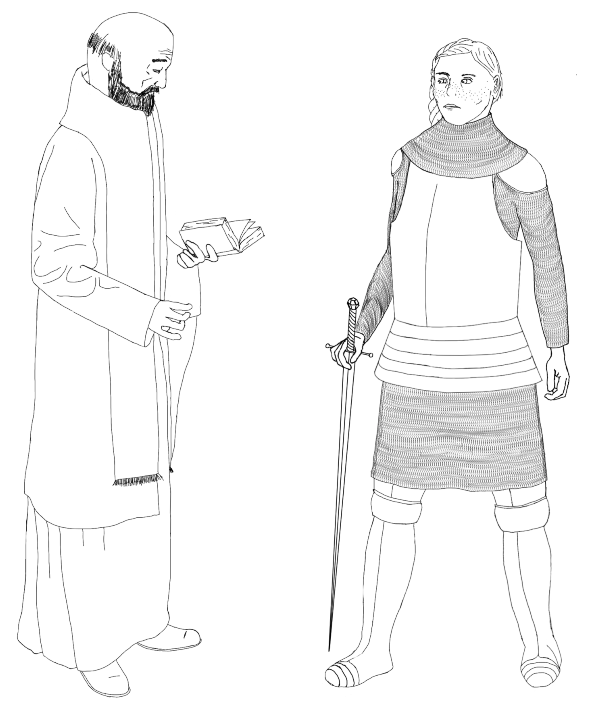
Clerical and militant clergy of the Western Reformed Church of Orneth
The Western Reformed Church of Orneth
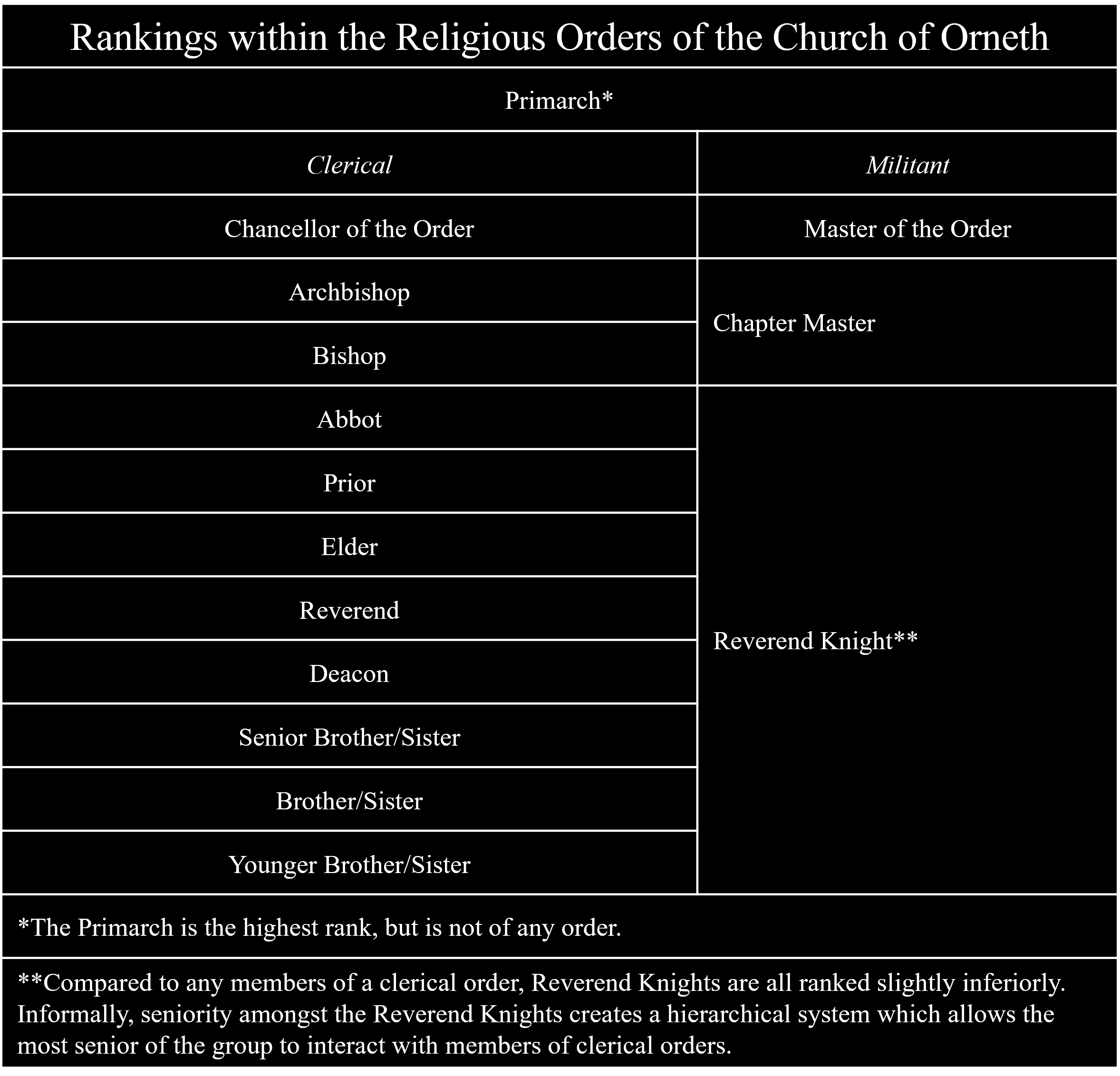
Administered from the Cathedral-Palace in Clovis, the church is divided into core leadership and twenty-six orders; thirteen clerical and thirteen militant. The Primarch offers or gives guidance and influences political leaders through bishoprics (usually one per large city, such as the city-states of Gersh and the large, non-capital cities of other realms), and archbishoprics (usually one per capital city of a major realm). The bishops administer religious services and teachings to their cities, significantly through their subordinate clergy, but also manage the enterprise of clergy in the smaller towns and villages to ensure the Church’s will and influence is felt amongst the commonfolk.
All clergypersons are members of one of the clerical orders with the exception of the Primarch. Primarchs are chosen from among the clerical orders and elected by the heads of each order, both clerical and militant (Table 3). The newly chosen Primarch leaves the order from which he or she originated. The heads of each order are elected from within each order, with a strong emphasis on seniority, and validated by the seated Primarch.
Each order is named after one of Orneth’s saints and endeavors,at least in their charter, to study and embody the teachings of their patron saint. The orders militant mirror the clerical orders in the name, an overlap of some studies, and a shared mentality. However, the orders militant are, by their conception, a force of well-trained and well-equipped soldiers and leaders of lay soldiers.
There are comparatively fewer members of the militant orders, and thus there are few chapters assigned outside of Clovis. Unlike members of the clerical orders, most Reverend Knights maintain estates around Clovis or southern Berkmar, where they train themselves and any soldiers whom they retain. In this way, the Knights Militant are largely the same population as the nobility of Clovis. The vast majority of all clergy members are ethnic-Berks, to the point of discrimination against non-Berks and those of impure Berk heritage.
Clergy members are permitted to marry, sire, birth, and raise children, and own property. Reverend Knights often marry other Reverend Knights. It is highly frowned upon for clerical members to take up arms. Most would suffer reprimand or disciplinary action of some, dictated by other members of their order, if they were found to be involved with any violent incident, though the first members of the orders militant were clerical members, so there is existing precedent in certain circumstances.