
Orcs
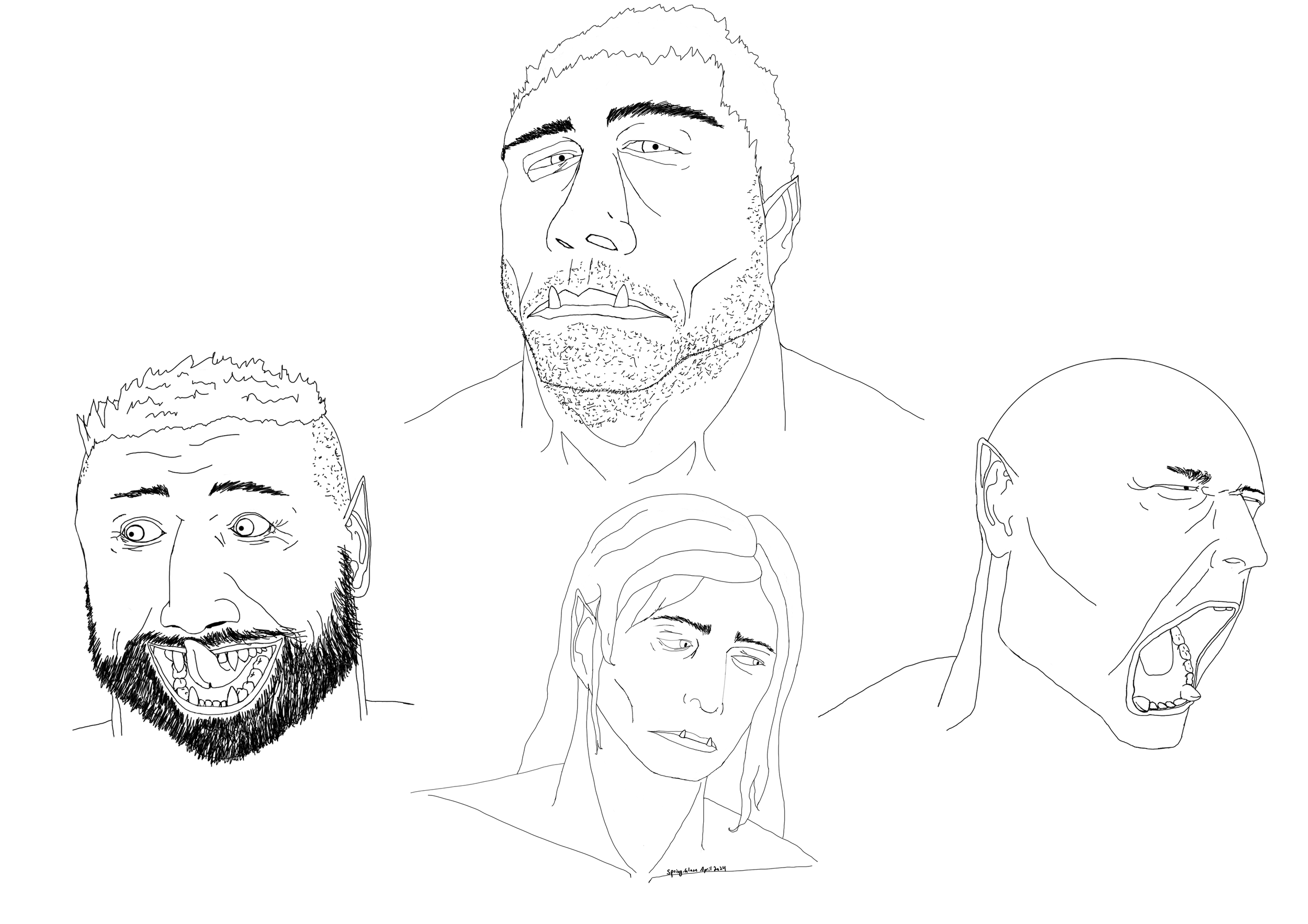
Orc Portraits
Overview
Orcs are large (seven feet tall is fairly common), highly aggressive, green-skinned humanoids. They are the most common of the cast out races, due to their high fertility rate. Their societies are largely based on tribal constructs and may be settled in villages or cities, be they nomadic or semi-nomadic.
Physiology, Appearance, and Ethnicity
Orcs are powerfully built humanoids with green skin, generally growing to nearly seven feet in height, give or take a half foot. Short orcs will be six feet tall or even less. The extremely tall orcs may reach eight feet in height. Their immune systems are notably robust. They have small tusks to help them tear meat, and large, powerful jaws for eating. Their eyes and ears are small, and the ears are pointed and backswept. Though their eyesight is not particularly strong, orcs have additional types of cells in their eyes that allow them to see infrared light or heat, sometimes called ‘heatsight.’ This vision typically takes over in the absence of normal visible light.
Their hands have small claws resembling jagged fingernails to aid in climbing and similar activities. They generally do not claw in combat, preferring weapons and fists, though they may bite with their tusks or headbutt with their thick skulls.
Orcs, originally created to quickly form a mass army, grow quickly into large and powerful frames. As such, their physiology shows many characteristics of this. They have a very high metabolism, so they consume large amounts of food, stay lean, grow height and muscle mass quickly, and age rapidly. An orc reaches physical adulthood at fourteen years of age, though many see violence and attempt to heap glory upon themselves as young as ten years old.
Most commonly, orcs die a violent death, usually at the hands of another orc before they are twenty-five years old. However, should an orc not meet a violent end, their natural lifespan will have them be senior in their forties and elderly by their fifties. Orcs in their late twenties have the same kind of health problems that humans do in their mid-forties. This relation continues: orcs in their early- to mid-thirties have the health problems that humans do in their fifties and sixties. Such is the price for growing too large so quickly.
As part of rapid growth and large muscle mass, orcs of both sexes have very high natural testosterone levels, which leads to common aggressive behaviors and violent competition in most situations. Orcs, particularly males, are subject to hair fragility, balding, and full-body baldness, especially as they age into their thirties. It is not incredibly uncommon for orcs (particularly men), to go bald as they reach adulthood. Facial hair is uncommon among orcs, but some have been known to grow beards, particularly in the northern tribes. Their high metabolism can cause skin disorders, mottling, psoriasis (which they call ‘itchy skin’), and excessive sweating. Orcs can become lethargic during warm weather, but need less clothing and warmth in cold weather than other races.
There is no great separation of ethnicities among orcs, like there visibly is with goblinkind. They are all green. Different shades of green are due to sun exposure, as changes with the time of year with differences in sunlight and weather.
Culture and Tribal Construct
Orcs, like the hobgoblins and elves, view themselves as a superior race over all others (and, in most cases, view men superior to women). The culture is competitive, violent, impatient to the point of instant gratification, prideful, and male-dominated almost without exception.
Their social order is based on tribes, led by a great one. The great one is the only one that has a name and it is the same name as the tribe. This differs from goblinkind, where each great one has a name different from the tribe and their deeds are recorded in the tribe’s history. In this way, the great one is the tribe and the tribe is an extension of the great one. For example, the Great One of the Baki-Norn is called the Baki-Norn. All of the members of the tribe are the Baki Norn (i.e. ‘we are Baki-Norn’ or ‘we are of the Baki-Norn,’ versus the Great One of the Baki-Norn who would say ‘I am the Baki-Norn’). The position of great one can be challenged by any orc, even orcs not in the tribe, though usually the incumbent wins.
Successful tribal great ones that see their tribes prosper through relative stability rule through fear of their combat prowess or can create a cult of personality based on actual or perceived competence (again, mainly martial competence). The few great ones that can transcend many of these difficulties and approach what humans would call a ‘king,’ a great one over several tribes, such as the Borys-Karang, would be able to not only do both, rule through fear and create a cult of personality, but also cleverly maneuver and manipulate rivals and potential rivals into eliminating one another while currying for favor. Most orcs, though, being short-sighted and craving gratification, do not have the patience required for such success.
At times when a great one needs to ensure his will is done, but has multiple commitments, he may appoint a subleader, called a Garad’Dai. Most orc great ones favor loyalty over competence, as loyalty is actually in shorter supply. Successful great ones sometimes find loyalty in orcs who are not strong or bold enough to achieve power on their own, but with the backing of their great one, can supply faithful and (relatively) effective service, though they are prone to abuse of power, however meager it may be.
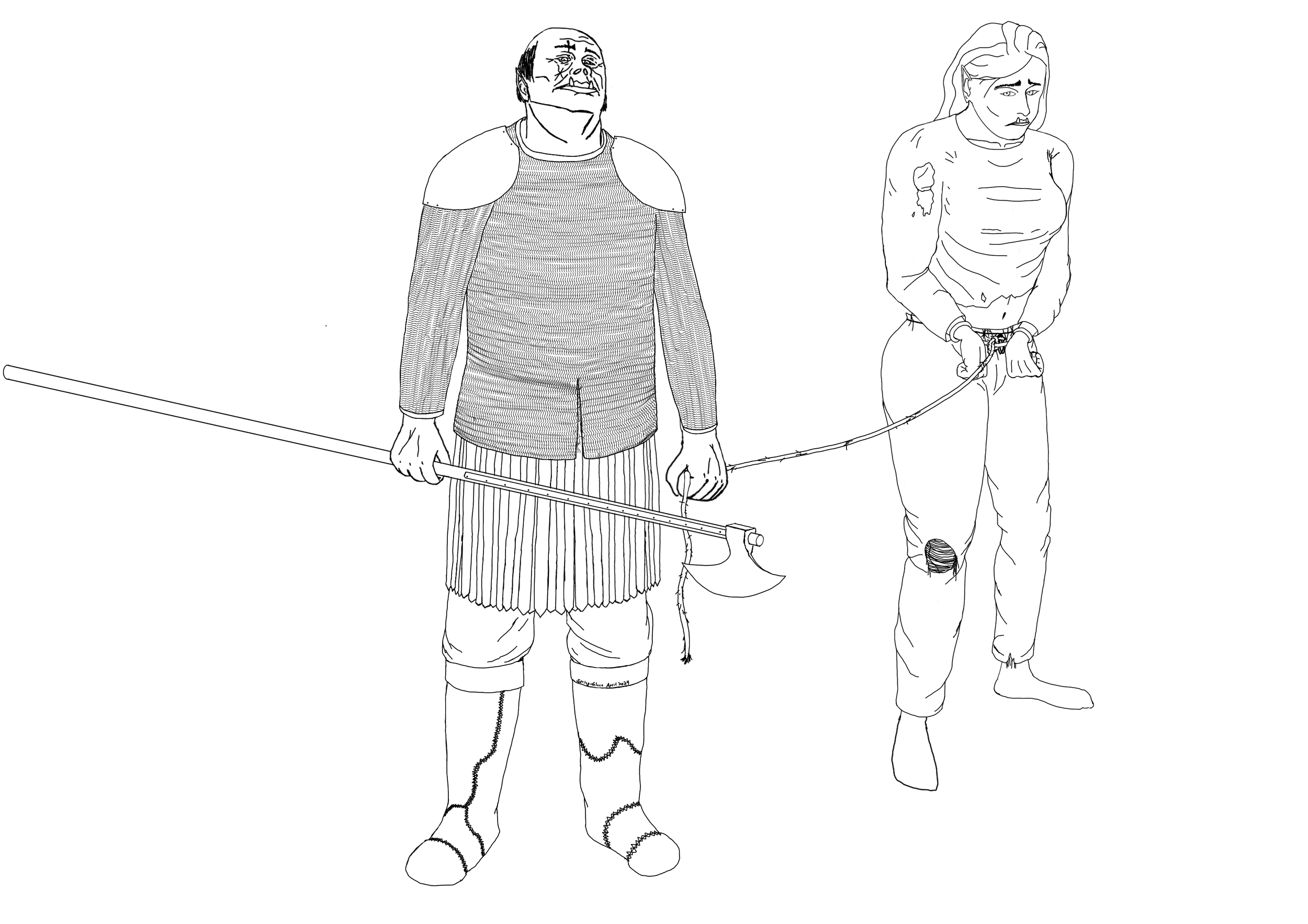
Orc Warrior and Female Orc Slave
The tribes are built around the adult male orcs. Each adult male’s worth is weighed by the number of kills that he has and the material wealth, most conspicuously including slaves, and the number of non-adult offspring that they have. Orc women are property of orc men, almost without exception. Orcs take any race for slaves, excepting other orc men, as orc men defeated in battle would be killed and their possessions absorbed.
Once a male orc offspring reaches adulthood, he leaves the household and starts his own. Though there may be some measure of familial fondness, both father and son view each other as enemies from that point forward. Orc daughters are sold, usually in exchange for other orcs’ daughters, though orcs have been known to kill each other to obtain a coming-of-age daughter.
The orcs worship, almost universally, a pantheon of four gods. They are the god of blood and strength, the god of skill, the god of fertility and prosperity, and the god of stuff. It is rare that orcs pray to these gods. They do not have clergy of any type or hold religious services, but they do swear by these gods and use these as guiding principles in how they prosecute life’s problems. The gods, in many ways, serve as a map to a successful life as an orc. Through strength and violence, one attains skill. Through skill, one attains prosperity, women, and produces offspring. Through prosperity, one attains material wealth.
Despite their very high birthrate, they are far from the dominant actor in the mountains. Their need to dominate races around their tribe succumbs to their need to dominate each other within their tribe. Life is short for them: shorter yet due to their violent culture, and they have a more short- or instant-gratification fixation than other races. They are generally too busy killing one another for position and absorbing one another’s material wealth to create a unified front against others.
Food and Drink
Orcs universally prefer meat over crops or even dairy products. Most orcs prefer at least some cooking, especially city-dwelling orcs, but some are indifferent and will eat their meat raw. These are usually in the nomadic tribes. Orcs do sometimes partake in cannibalism, but there is no ritual to it. In that case, meat is meat.
Most orc cooking is simple roasting or stewing, though demanding or particular tribal great ones will expect their slaves to prepare more elaborate meals ahead of time and anticipate the great one’s hunger.
As with their food, orcs bend to their preference for gratification sooner rather than later with their drink. Much of the time, they drink water or fresh-squeezed juice from foraged berries and fruits. Mostly among nomadic and semi-nomadic tribes, they will also drink the blood of their hunted game or defeated foes. Orcs uncommonly prepare alcoholic drinks, due to the time required for fermentation (even if it is only a few days). Again, demanding and particular tribal great ones may be the exception and have their slaves ferment roots and berries to make various alcoholic drinks. Most alcohol that orcs drink is the boon of trade or loot.
Most any orc at war, whether city-dwelling or nomadic, will have no qualms about eating raw meat, eating their own dead, the enemy dead, the dead of their ‘allies,’ or drinking their blood. This is not to say they go out of their way to do it, but rather just a matter of expediency. If there is a properly supplied and ready field mess, orcs will take the cooked food (especially city-dwelling orcs).
Hygiene and Fashion
Orcs’ high metabolism can cause skin conditions, the most common of which is skin sensitivity. As a result of this, orcs commonly bathe at least once every five days due to their skin discomfort. This bathing is nothing elaborate and largely consists of splashing and rubbing water on themselves, usually cold mountain stream water, and scrubbing with reeds, grass, sand, or mud (achieving an exfoliation). On the whole, orcs are generally clean.
Orcs generally prefer clothing that accentuates traits of which they are proud of. If they have a steel breastplate, they will usually wear it as part of regular clothing. If they are particularly strong, they may wear sleeveless garments. Aside from serving as a vehicle for their pride, clothing follows the barest necessities of function. If made by themselves or other orcs, the garments are generally crudely stitched. They prefer materials that require less preparation, such as furs, rather than leather or woven fiber textiles. If they have non-orc slaves, they may force them to make higher quality clothing and rush them along the way.
The exceptions, once again, are farseeing and wise great ones, such as the Borys-Karang, who understands the benefit of properly made equipment, and imposes requirements on his tribe.
Music
Orc music largely consists of singing and chanting, especially among the nomadic tribes. These songs usually come in the form of an orc boasting about his exploits and abilities. A group of orcs singing will, on a good day, be jeering one another by singing counters to one another’s songs, downplaying other’s virtues while embellishing their own. Drums might be employed, but are used to emphasize sung lines. When drums are used, it is by a singer. Settled orcs tend to use a few more instruments, but it is still focused on one singer-musician.
Language
Orc dialects are varied and many; however, nearby dialects can generally be understood with some gaps in vocabulary. There is more than one set of symbols for the written form of Orc. Some are phonetic, some are pictograms, and some borrow from modern Goblin or even Dwarven runes, depending on the area. While spoken Orcish could perhaps be generally understood, forms of written Orcish have a higher instance of being excluded from mutual understanding.
Cities
Orcs do build cities, but they have a strong tendency to be piecemeal with winding streets and disparate building types. Cities usually start out as the settlements of strong tribes and grow as the tribe gets stronger. Orc cities also come about as several tribes settle in the same area, neither strong enough to annihilate the other and reaching some kind of agreement, each great one thinking that they are using the other to their advantage or against a common enemy (such as humans, elves, dwarves, or goblinkind). The most prominent example of an orc-built city is the city of Ghetrak, nestled in the central Kaskevs.
Well-built orc cities are usually captured and occupied cities. Ikria is the best example, built by the dwarves of Drenia and lost to the orc hordes as the Kingdom of Drenia waned in power and influence.
Organization for War
Orcs have a rather simplistic framework of organizing their forces for conflict with external entities.
● Warband: As many warriors as the local contingent of the tribe can put in the field, which varies by tribe. The warband typically travels with all of its property and noncombatants, unless it is an urban tribe or fielding a partial warband.
● Horde: For larger tribes, such as the Borys-Karang, as many warriors as the tribe can put in the field in aggregate. This echelon generally struggles with logistics as it is a large force for forage; internal theft and violent disputes are common.
Arms and Armor
The armament of orcs varies widely with the most common discriminator being the tribe. For example, smaller and weaker nomadic tribes, like the Baki-Norn, do not smith their own steel weaponry: they trade for it or take it as spoils, so what weapons they bring to fight varies widely, while the armor they craft is predominantly thick animal hides or no armor at all. On the other hand, a powerful tribe that is largely settled, conducts trade, and maintains a robust economy, like the Borys-Karang, forges their own steel weapons and armor and equips specialized troops to their task. For example, scouts of the Borys-Karang generally will be protected by boiled leather armor, carry shortbows (scaled to their size) constructed of laminated strips of wood, steel hand axes, round shields, and steel knives.
Common styles of weapons are long-hafted axes, commonly seen with combinations of spikes, blades, hooks or hammerheads on the back or top of the axe head and perhaps spikes on the butt end of the shaft. Orc smiths (or smiths that are slaves to the orcs) primarily forge two styles of swords. On the western slopes, orcs frequently carry square-tipped, two-handed falchions, versus the eastern style of a single-edged, forward-curving blade on a two-handed haft. Orcs also carry throwing javelins, three-pace-long spears (eight-foot shaft), clubs, maces, and so forth. Crossbows are uncommon, but bows are frequent enough among some tribes.